DISPERSOL DLD-100 - Dispersing Agent, Removal Fixing Agent
CHARACTERISTICS:
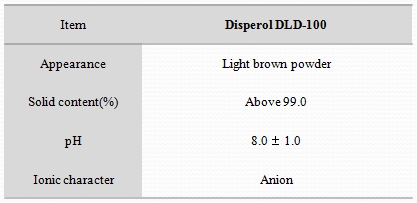
APPLICATIONS:
- Dispersing agent in disperse dyeing of polyester, acetate and polyamide fibres.
- Dispersing agent / colloid protective in VAT dyeing.
- Discharging agent for cationic dyes and, generally speaking, for all cationic products applied on acrylic fibres.
- Stabilizer of stock-VAT dyes.
TECHNICAL/APPLICATIVE CHARACTERISTICS:
- Excellent dispersing power of disperse dyes
- Excellent dispersing power of eventual agglomerates that may born in VAT dyeing
- Easily usable
- Excellent resistance to salts, acids, alkalis and hard water.
RECOMMENDATIONS OF USE:
DISPEROL DLD-100 is used in disperse dyeing of synthetics in quantities between 0.2 and 0.4 g/l when used for dyeing of polyamide and acetate fibres, between 0.5 and 1 g/l when used for polyester dyeing.
In both cases the addition of the most appropriate levelling, migrating agents, such as Unilevel Series (1 - 2 g/l on polyamide and acetate fibres) or Disperol Series (0.5 - 2 g/l on polyester fibre) is recommended to achieve the best levelling results.
DISPEROL DLD-100 used in VAT dyeing according to following methods:
- Half-pigmentation by exhaustion (bobins)
- Pigmentation by exhaustion (jigger - overflow)
- Pigmentation by foulard
- Dyeing of polyester/cotton blends with pre-blended disperse/VAT dyes
is generally applied at concentrations between 0.5 and 2 g/l.
As stock-VAT dyes stabilizer, i DISPEROL DLD-100 s used at a dosage of 3 - 6 g/l.
DISPEROL DLD-100 is also used as discharging agent of cationic dyes and cationic products, e.g. softeners, retardants, etc., on acrylic fibres boiling with 2.5 - 5% product for 40 - 60 minutes.
Handling and storage method
Do not use for another purposes other than recommended use.
Avoid contacting eyes and skin and wash enough w ith a plenty of water in case of contact.
Can be stored in natural condition and especially should not freeze and avoid direct sunlight
|





